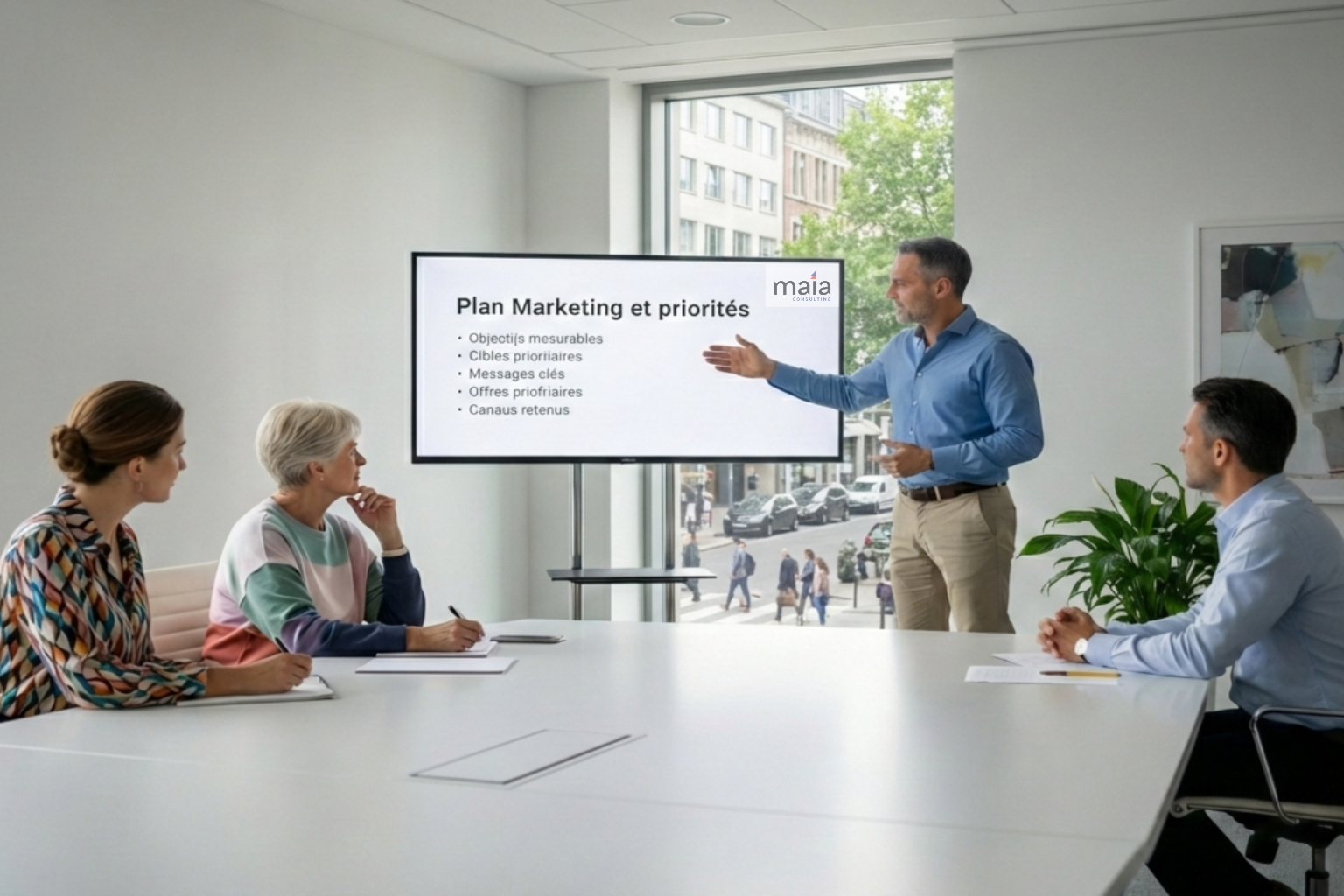
A marketing plan for a B2B small business is primarily used to guide
A marketing plan is not a publishing calendar.
Nor is it a list of ideas or a series of unrelated campaigns.
A marketing plan is a strategic document. It links business objectives to specific marketing actions. It outlines what will be done, when, by whom, with what budget, and how progress will be tracked.
For B2B small and medium-sized businesses, the goal is simple: to avoid making decisions on the fly and to maintain a realistic pace. A good plan doesn’t try to anticipate everything. It sets a clear framework for sustained execution.
Marketing Strategy vs. Marketing Plan
Two different, complementary concepts.
- Marketing Strategy: Key Decisions (priority markets and target audiences, positioning, objectives, products and services to highlight, value proposition).
- Marketing Plan: Organizing the Execution (actions, channels, budget, resources, schedule, monitoring).
If the strategy is vague, the plan will go off in all directions. If there is no plan, the strategy won't be of much use.
What a Marketing Plan Should Include
For your plan to be complete, it must include the following elements:
- Measurable Objectives (what, how much, when)
- Priority Targets (Who Are We Targeting?)
- Key Messages (what we want people to understand)
- Priority Opportunities (Where to Focus Efforts)
- Channels We've Chosen (and the Ones We're Not Using)
- Action Plan (Key Initiatives and Deliverables + Timeline)
- Budget (total allocation + breakdown)
- Human Resources (Who Does What)
- Tools and processes (CRM, email, analytics, content, AI)
- Indicators and Management Frequency (Simple, Regular Monitoring)
It can fit on a few pages. The point isn't the length. It's the clarity.
To create this plan, you can follow the 7 simple steps below. They will help you fill in the key elements.
Step 1: Clarify the objectives
A marketing goal is not an action. “Doing SEO,” “posting on LinkedIn,” or “putting out a newsletter” are not goals.
An objective describes an expected outcome within a defined timeframe. And it should be possible to track progress toward it using simple metrics.
Visibility and brand awareness are legitimate goals. The problem arises when they aren't properly managed.
For example,
- Visibility: Increase our reach among our target decision-makers across three key topics, with monthly tracking of impressions and traffic on the associated pages.
- Credibility: Create content and increase engagement with “decision-making” content (customer case studies, product pages, guides) and the time spent on these pages.
- Request: Increase the number of leads generated from a priority offer (forms, requests for demos or quotes, calls).
- Sales Support: Standardize the materials and messaging used by the sales team (pitch decks, one-pagers) and ensure they are used.
In an SME, aim for 3 to 4 objectives at most. Any more than that, and things will get complicated.
Step 2: Select priority targets
Many B2B small and medium-sized businesses try to appeal to everyone. The result: generic messages, generic content, and generic campaigns.
To develop a plan, you have to make choices. Start with two or three priority audiences—no more than that.
You can think about it this way:
- Decision-maker: the person who approves the budget.
- Influencer: someone who influences the recommendation.
- User/Operations: the person who will be using the solution on a day-to-day basis.
Based on this, you simply describe each target audience (known as buyer personas): their goals, their constraints, their common questions, and what would motivate them to schedule a meeting or make a decision.
Example:
- Decision-maker: understands the value and agrees to a meeting.
- Prescriber: compares and makes recommendations internally.
- Operational: validates feasibility and minimizes objections.
This work requires adapting messages and formats, and helps avoid creating content just for the sake of it.
Step 3: Define positioning and key messages
The marketing plan should not redefine the positioning every quarter. It should be based on a stable core marketing foundation.
You need three clear elements:
- Value Proposition: Why You, and Not Someone Else.
- Differentiation: What Really Sets You Apart (Not Just a Slogan).
- Key messages: 3 to 5 messages that appear throughout the document.
An example that’s “too generic”:
“We support our clients with a flexible, customized solution.”
That could describe a large portion of the market.
A “more specific” example:
“We help our clients reduce decision-making risk by providing concrete evidence, clear comparisons, and standardized materials to align teams.”
Try this simple test: if the website, the sales pitch, and the content all say different things, the marketing plan will be ineffective.
Step 4: Select the levers and channels
The purpose of a marketing plan is to set priorities—not to do everything.
List the possible strategies: content, SEO, LinkedIn, email marketing, paid campaigns, events, partnerships, media relations, etc. Then select them based on practical criteria.
Useful criteria for small and medium-sized enterprises:
- Where your target audience is actually active.
- What you can produce on a regular basis (actual capacity).
- The expected timeframe for results (short-term vs. long-term).
- The total cost (not just media buying, but also production).
- The ability to maintain the channel for 6–12 months.
And write down what you don't do. That's the most useful part for ensuring proper execution.
Example: “No new channels in 2027 until SEO, LinkedIn, and email marketing are established.” This prevents spreading ourselves too thin.
Step 5: Develop the action plan (deliverables + timeline)
An action plan must be concrete. It must move beyond simply saying “we’re going to communicate” and focus on deliverables.
Examples of typical deliverables in B2B SMEs:
- Clear definition of offers (and updates)
- Case Studies and Evidence (Testimonials, Statistics, Before-and-After)
- Email Sequences and Content
- In-depth content on 2 or 3 strategic topics
- Standardized sales materials (one-pagers, presentation decks, responses to objections)
- One-time campaigns (highlights)
- Distribution Activities (Distribution Through Partners or Events)
Step 6: Define the resources (budget, personnel, tools)
This is where many plans fall short: the actions are listed, but the resources aren't there to support them.
1. Budget
A plan must include:
- An annual budget (even if it's just a rough estimate at first)
- A breakdown by major categories: production (content/visuals), campaigns, tools, service providers, events
- Some leeway for unforeseen circumstances
If you don't have a formal "marketing" budget, at least create a budget for each category.
Example: X days of in-house production, Y budget for vendors, Z budget for campaigns. This makes the reality clear and helps avoid surprises.
2. Human Resources
Specifies that:
- Project Manager (Accountable for Results)
- Execution (production, launch, campaigns)
- Valid (management, sales, technical)
Without a clear assignment, you're at the mercy of others' goodwill and whatever comes up. And that's not sustainable over 12 months.
3. Tools
You don't need 15 tools. You need a reliable set of essentials:
- Website/CMS
- Analytics
- CRM (even a simple one)
- Email Marketing
- Generative AI
- A shared space for content and visuals (library)
4. AI: useful if the framework is clear
AI can help a B2B small business, but it cannot replace strategy, market knowledge, or the discipline required for execution. It works well when the objectives, targets, messages, and production process are already in place.
Practical Applications (Most Useful for Small and Medium-Sized Enterprises):
- Content creation: first drafts, rewriting, structuring articles, creating variations of LinkedIn posts, summarizing internal memos, and developing an editorial calendar based on defined topics.
- Analysis and strategic planning: helps clarify options, compare positioning strategies, identify customer objections to address, and develop core sales pitches.
- Data analysis: reviewing and summarizing data (analytics, CRM, market research), identifying trends, basic segmentation, and summarizing sales feedback.
- Research and market studies: formulating questions, preparing for interviews, synthesizing existing information, and conducting online research (using reliable sources).
A minimum level of training and guidelines for use must be established: confidentiality, validation, sources, and editorial responsibility. Without these, AI quickly produces generic content and makes decisions based on approximations.
Step 7: Oversight and Responsibilities (Putting the Plan “into Action”)
Putting a plan in place means establishing a rhythm and clarifying who makes the decisions.
Two rituals are all it takes:
- Monthly review (30–45 minutes): progress and follow-up on actions, a few key figures, decisions.
- Quarterly Review: Adjusting Priorities Without Starting from Scratch.
The plan must have one person in charge—period. Not “marketing” or “the team.” One person. Even if the work is split between internal and external teams, someone has to make the calls, make decisions, and keep things moving.
Conclusion
Developing a marketing plan for a B2B small business means creating something actionable: measurable objectives, priority targets, clear messages, selected channels, planned actions, a defined budget, assigned responsibilities, and a simple management process.
You don't need a perfect plan. You need a plan that stands the test of time and keeps you from getting sidetracked.
At Maia Consulting, we provide practical support to B2B SMEs in these areas: strategic scoping, decision-making, planning, execution, and oversight. If you’d like to review your 2027 plan (clarity, realism, budget, resources), let’s have a casual chat.