
Optimize your sales pipeline: lead scoring, sales-marketing SLAs, and forecasting
In many Belgian SMEs, the sales pipeline resembles an attic. It contains dozens of opportunities, leads collected at a trade show eight months ago, quotes that went nowhere, and a few truly promising deals, all buried in the rest. As a result, marketing feels like they're just delivering leads, sales considers them poor quality, and management only finds out the quarterly figures after the quarter is over.
The problem rarely stems from a lack of leads. It comes from a full but unmanaged pipeline. Three levers can correct this: lead scoring for prioritization, a sales-marketing SLA to structure collaboration, and forecasting for predicting. Taken individually, they offer little benefit. Combined, they form a system that makes your growth transparent.
Here is the method, adapted to the realities of an SME: small teams, sometimes under-utilized CRM, and little time to devote to administrative tasks.
Why your pipeline is leaking (and what it costs)
Common symptoms in SMEs
There are some telltale signs:
- Leads not followed up : a form filled out on Monday receives a response on Thursday, or even never.
- A persistent disagreement between sales and marketing : marketing counts forms, sales counts signed contracts, and nobody is talking about the same thing.
- A "gut feeling" forecast : the figure announced in committee is based on the salesman's optimism, not on data.
- An unreliable CRM : unclear steps, closing dates never updated, "zombie" opportunities that artificially inflate the pipeline.
The impact on sales revenue and sales time
In a small or medium-sized enterprise (SME), a salesperson who spends part of their week following up with prospects who have no potential is taking time away from the opportunities that matter. For a team of three or four people, this distraction directly impacts revenue. And an inaccurate sales forecast then skews hiring, inventory, and cash flow decisions.
To understand where your organization stands, you can assess your SME's marketing maturity in 3 minutes . This is a good starting point before making any changes to your pipeline.
Lead scoring: prioritizing the right prospects
What is lead scoring?
Lead scoring involves assigning a score to each lead based on two questions: is it the right profile? and is it genuinely interested in us? This score allows salespeople to prioritize the most promising prospects, and marketing to know when a lead is ready to be passed on.
Demographic scoring (fit) vs behavioral scoring (engagement)
A good score combines two dimensions:
- The fit (or demographic score) : sector, company size, contact function, geographic area. It measures the proximity to your ideal client.
- Engagement (or behavioral score) : pages visited, downloads, email opens, demo requests, webinar participation. It measures current interest.
An industrial director of an 80-person SME who has never opened an email doesn't have the same status as a student who downloads three white papers. The former has a good fit and low engagement. The latter has high engagement and no fit. Only the combination of the two provides a true picture.
One important point to note: behavioral scoring relies on tracking browsing activity, and therefore on personal data. Consent to cookies, clear information in your privacy policy, and limited data retention periods are essential. The applicable rules in Belgium are detailed on the website of the Data Protection Authority .
Build a simple grid in 5 steps
In SMEs, a simple and used grid is better than a sophisticated model that is ignored.
- Analyze your last 20 to 30 deals won. What commonalities do they have (sector, size, function, lead source)?
- Define 4 to 6 fit criteria and assign points to them (for example: +20 for a decision-maker, +15 for an SME of 20 to 200 people in your target sector).
- Define 4 to 6 engagement criteria (for example: +30 for a contact request, +10 for a download, +5 per visit to the pricing page).
- Consider the following negative points : personal email address, competitor, student, lack of activity for 60 days.
- Test on your historical leads : did the deals won have a high score? Adjust before deploying.
MQL and SQL thresholds: when to hand it off to sales
Two statuses structure the handover of power:
- MQL (Marketing Qualified Lead) : the lead matches the target profile and shows an initial interest. Marketing continues to nurture it.
- SQL (Sales Qualified Lead) : The lead is ready for a sales conversation. The salesperson takes charge.
Set a numerical threshold for each status (e.g., MQL at 40 points, SQL at 70), and specify that a contact or demo request directly moves a lead to SQL, regardless of its score.
Common mistakes to avoid
- Build the grid without the salespeople. They're the ones who know what a good lead is.
- Multiply the criteria. Beyond a dozen, no one understands the rating anymore.
- Never revise the grid. The market evolves: review your criteria every quarter.
- Forget about declining leads. A lead that was active six months ago isn't necessarily hot today. Lower the score over time.
The sales-marketing SLA: a team contract
Definition and importance of an internal ALS
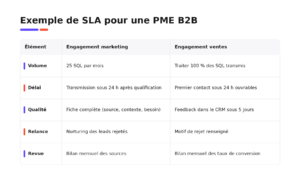
A sales-marketing SLA (Service Level Agreement) is a reciprocal, written, and quantified commitment between the two teams. It answers a simple question: who does what, by when, and to what standard? Without it, each team defends its own territory. With it, they share a common goal: the revenue generated.
In a small or medium-sized enterprise (SME) where marketing and sales are sometimes handled by just one or two people each, this framework might seem superfluous. However, this is precisely where it is most useful, as it prevents tensions from arising due to a lack of explicit rules.
What marketing promises to deliver
- A volume of MQLs or SQLs per month, aligned with the revenue target.
- A measurable quality : adherence to the scoring grid, complete data in the CRM.
- Context for each lead: source, content viewed, expressed need. Salespeople should never cold call someone who has already read three of your articles.
What sales commits to doing
- A first contact timeframe : for example, less than 24 working hours for an SQL, and less than 2 hours for a demo request.
- A defined number of contact attempts (for example, 5 attempts over 3 weeks, by email and telephone).
- Mandatory feedback in the CRM: lead accepted, rejected with reason, or to be redirected to marketing.
- Status updates within 48 hours of each significant interaction.
Follow-up rituals
An unfollowed SLA is a dead document. Two meetings are enough:
- A weekly 20-minute meeting : pending leads, blockages, feedback from the field.
- A monthly one-hour review : MQL to SQL conversion rate, SQL to opportunity, opportunity to sale, and grid adjustment.
It is the regularity of these rituals, far more than the sophistication of the tools, that establishes lasting alignment between the two teams.
The forecast: moving from intuition to prediction
Define clear pipeline stages and exit criteria
A reliable forecast starts with a structured pipeline. Each step should correspond to a customer action , not a salesperson's impression. For example:
- Qualification : needs and budget confirmed.
- Discovery : meeting held, decision-makers identified.
- Proposal : Offer sent.
- Negotiation : discussion on the conditions.
- Won or lost .
For each stage, write an exit criterion : what must be true for an opportunity to move to the next stage. "The prospect seems interested" is not one. "The decision-maker has approved the budget in writing" is one.
Conversion rate per step and weighted probability
Calculate, over your last 12 months, the percentage of opportunities that move from one stage to the next. This gives you a realistic probability of closing at each stage. The weighted forecast then becomes:
Forecast = sum of (opportunity amount × stage probability)
An opportunity worth €40,000 in the proposal phase, with an observed probability of 35%, weighs €14,000 in your forecast, not €40,000.
Key indicators to monitor
- The conversion rate at each stage.
- Velocity : the average length of the sales cycle. It helps determine if a deal declared "for this month" is credible.
- The average size of deals , to detect discrepancies in discounts or targeting.
- Pipeline coverage : the ratio between the pipeline value and the target. A coverage of 3 times the target is a common benchmark, to be calibrated according to your own conversion rates.
Ensuring the reliability of data in the CRM
No forecast can withstand a poorly maintained CRM. A few simple rules:
- Make the key fields mandatory (amount, closing date, stage, source).
- Clean the pipeline every month: any opportunity without activity for 60 days is requalified or closed.
- Making CRM the sole source of truth : if it's not in CRM, it doesn't exist for the committee.
Maia Consulting supports Belgian B2B SMEs with a senior consultant who integrates into your team, for one or two days per week:
- In-house marketing mission : a part-time marketing manager who leads the strategy, tools and alignment with your sales team over several months.
- Marketing audit and strategy : a one-off mission to diagnose your pipeline and deliver a clear roadmap in a few weeks.
- AI support and training : to automate scoring, qualification and reporting with tools adapted to your size.