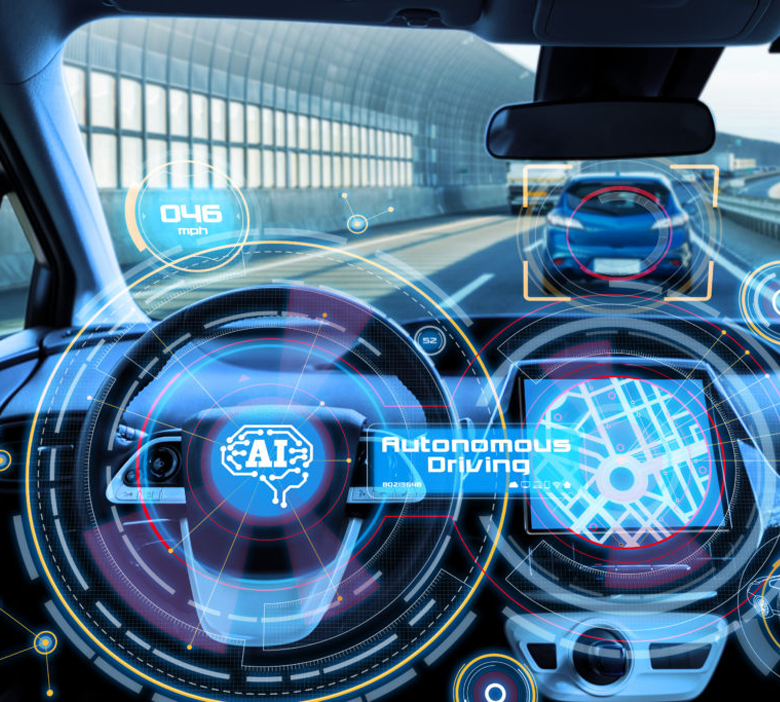
How Is Ambient Computing Shaping Our Future Driving Experience?
With the arrival of the Android Automotive OS, we are gradually entering the era ofAmbient Computing. Ambient Computing, orubiquitous computing, is the third era in the history of computing, following the use of mainframe computers and then personal computers (PCs). This third era currently relies on mobile devices and smart speakers. We are only at the beginning of this new revolution, and with the arrivalof Android Automotive, this phenomenon will gain momentum. Want to learn more? Then follow along.
The driving experience is about to change dramatically
For the most part, automakers have developed their own infotainment screens and systems, some more polished than others. But let’s be honest: the user experience (UX) offered in our cars has never matched the UX provided by our Android smartphones and their many apps, such as Google Maps, Waze, Google Search, and so on. Even with Android Auto or Apple CarPlay, let’s face it: the user experience leaves something to be desired. It’s often impossible to display the GPS on the screen behind the steering wheel or on the head-up display. It’s often difficult to enter a destination correctly without having to handle your phone—a safety hazard when you’re behind the wheel. The main difference between Android Automotive and Android Auto is that the integrated version designed for cars can control all vehicle functions, such as air conditioning, heating, heated seats, and audio features. Plus, with Google Assistant, you can control most vehicle functions using only your voice—and that’s where the real revolution lies.
With Android Automotive, your car becomes another device, just like your phone. You’ll be able to personalize your driving experience by downloading your favorite apps to your car’s screens. You’ll be able to monitor settings remotely, and since everything will be synced with your Google account, switching cars won’t require any adjustment. The experience will be such that we’ll choose the makes and models that are compatible with the operating system we’re used to using.
Ambient Computing: Intelligence as a Travel Companion
We can view Ambient Computing as intelligence that is present everywhere and at all times; it is an era of convergence in which a wide range of “smart” devices communicate with one another in a non-intrusive and nearly invisible way, offering—based on an analysis of our actions and habits—an unprecedented experience by anticipating our requests and expectations. In the case of cars equipped with Android Automotive, the system will be able to notify you of the departure time for your appointment based on traffic conditions, preheat or cool the cabin based on the weather, check whether the battery will last long enough to get you to your appointment, and if not, it will plan a stop at a charging station and, consequently, adjust your departure time to ensure you arrive at your appointment on time. It will even remind you of your loved ones’ birthdays and suggest stopping by a florist or a chocolatier. In short, as you can see, the car will become a true personal assistant. And all of this will be controlled by voice, since that’s the most natural means of communication for human beings.
Smartphones will soon be relegated to the back of our closets
Well, not right away, but we’ll get there faster than we think. We’ll be immersed in technology, and it will be there to help us without us having to hide behind our screens. People will be brought back to the forefront, aided by technology that is everywhere but integrated into our everyday environment. In fact, we won’t need to pull out our smartphones anymore to answer a question or look up a recipe. Either our car will answer it, or our smart fridge will.
If we take this a step further, one day we’ll have lenses that give us access to our favorite apps and, with just a glance, let us perform tasks so easily that there will no longer be a boundary between the real and the digital worlds. Some people think this is science fiction, but I assure you that our beloved smartphone will become a museum piece, just as so many devices before it did following its arrival.
A column by Simon-Pierre Breuls, founder of Maia Consulting. Published in *L'Echo* on May 20, 2021.