
Your small business has a website, posts regularly on LinkedIn, and attends a few trade shows. You may also be investing in Google Ads. Yet when asked how many customers come from these efforts, the answer isn’t always clear.
It isn't necessarily a visibility issue. Sometimes there's simply a missing link between your marketing efforts and your sales strategy.
That is precisely the role of a B2B acquisition funnel—also known as an acquisition pipeline—to organize the journey that takes a prospect from discovering your company to an initial sales conversation, and eventually to a sale.
Rest assured, there’s no need to invest in expensive software or build dozens of automated workflows. For a small or medium-sized business, just a few well-thought-out steps can already improve this customer journey.
The Stages of a B2B Acquisition Funnel
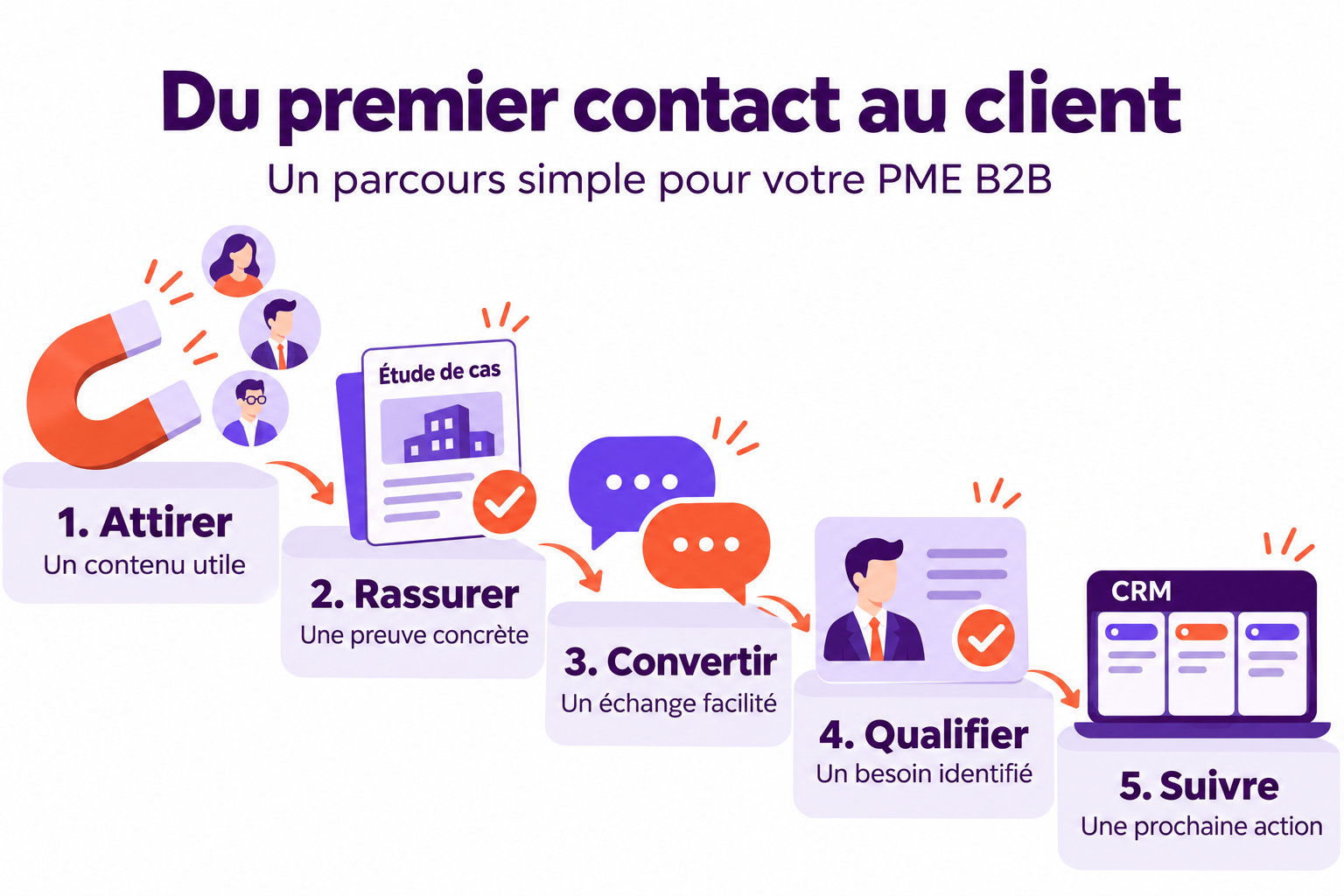
Here are 7 tips to get you started, with real-life examples and common mistakes to avoid.
1. Start with your best customers, not with too broad an audience
Before you ask yourself how to attract more prospects, ask yourself another question: Which customers do you really want to work with?
Let's take the example of a Walloon small and medium-sized enterprise that specializes in industrial maintenance.
It could target all companies that have machines. But such an approach risks producing messages that are too generic.
Looking at her client portfolio, she may realize that agri-food companies are a particularly good fit for her expertise. She therefore decides to focus her first campaign on this sector.
All that remains is to identify the people we need to convince.
This is where buyer personas come into play. A persona represents a profile of a customer or decision-maker, based on real-world information.
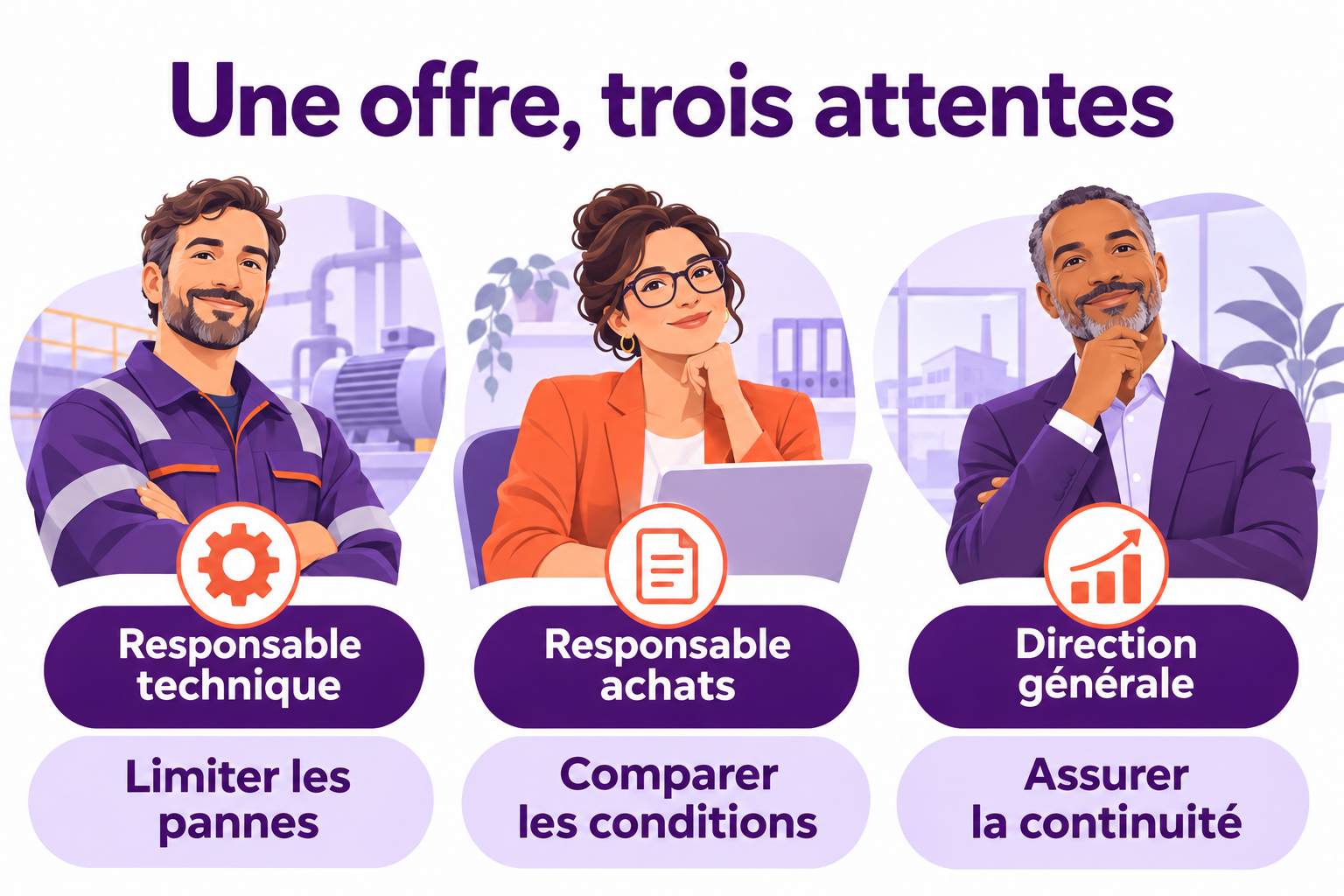
For the same maintenance service, expectations may vary:
- The technical manager wants to minimize breakdowns and production stoppages.
- The purchasing manager compares terms, warranties, and costs.
- The CEO is focused on business continuity and the profitability of investments.
You're selling the same service, but you shouldn't necessarily present it the same way to everyone.
Here’s a tip: Take a look at your last 10 clients and examine their industry, your contact’s role, the problem they faced, and why they chose your company. A few discussions with your sales representatives can round out this analysis.
You'll already have a solid foundation for identifying one or two priority personas.
The mistake to avoid: trying to reach all sectors and all decision-makers with a single campaign.
To learn more about this topic, check out our article: Using Existing Data to Define Your Buyer Personas.
2. Give your prospects a good reason to be interested in you
Once you've identified your target audience, you still need to figure out what will capture their attention.
And it's not always a presentation of your products or services.
A maintenance manager who is concerned about the reliability of his facilities isn’t necessarily looking for “an innovative partner offering customized solutions.” Above all, he wants to know how to prevent a breakdown, prepare for a service call, or reduce recurring problems.
Your initial contact should therefore address their concerns.
Let's go back to our industrial SME. Rather than launching a broad campaign promoting its services, it could offer:
- A checklist of items to check before a maintenance shutdown.
- An article explaining common mistakes in facility maintenance.
- An initial technical discussion to identify the risks associated with a piece of equipment.
Not all of these resources serve the same purpose. The checklist helps the prospect understand their problem. The technical discussion, on the other hand, is aimed at someone who is already considering taking action.
This is an important distinction in a B2B acquisition funnel: not everyone is ready to request a quote right from the first point of contact.
Here’s a tip: For each priority persona, note the three questions they ask most often before making a purchase. Choose one and create a helpful response: an article, a how-to guide, a comparison chart, or a diagnostic tool.
The mistake to avoid: creating a 30-page white paper that mainly introduces your company. If the document doesn’t answer a real question, there will be little reason for anyone to read it.
3. Show what you've already accomplished to reassure your future clients
In B2B, choosing a supplier often involves multiple people, a budget, and sometimes the continuity of operations.
So the quality of your sales pitch isn't always enough. Your prospects want to know if you've ever worked on a project similar to theirs.
That’s why testimonials and case studies have an important role to play in an acquisition funnel.
Let's imagine that a technical manager discovers your company on LinkedIn. He then visits your website to check your skills.
There are two possible scenarios:
- He finds a page listing your values, your equipment, and your experience.
- He discovers a project carried out at a factory similar to his own, including the challenges encountered, the solutions implemented, and photos of the installation.
The second presentation makes it easier for him to visualize the future.
You don't need to produce a very elaborate case study. A single page structured around four questions may be enough: What was the client's need? What constraints had to be met? What did you accomplish? And what was the result?
When a specific figure is available, use it. Otherwise, a precise description of the achievement is preferable to an unverifiable promise.
Here’s a tip: Select two or three projects that are representative of the clients you want to attract. Turn them into reusable content for your website, sales presentations, and LinkedIn.
The mistake to avoid: displaying only client logos. A testimonial becomes truly valuable when it explains what you did and for whom.
We also explain how content can support the purchasing decision in our article on content marketing for B2B SMEs.
4. Choose your acquisition channels based on your personas' habits
Should you invest in Google Ads? Post more on LinkedIn? Improve your website's SEO? Attend trade shows?
The answer depends mainly on your customers.
If your prospects are actively searching for a solution on Google, SEO and search engine campaigns may be relevant.
If you’re targeting a few dozen specific companies in a niche sector, a personalized approach, expert content, or your professional network may be more appropriate.
And in certain industrial sectors, trade shows and referrals remain important points of contact.
So the question isn't which channel is the most popular, but where your personas look for information and how they identify their suppliers.
For our small business specializing in industrial maintenance, an initial campaign could be fairly simple:
- Publish a technical article that addresses a common question from maintenance managers.
- Share it on LinkedIn with the relevant profiles.
- Include a link to a page offering a technical discussion.
- Track visits, inquiries received, and appointments scheduled.
A single route that's easy to understand and measure.
Here's a tip: Choose a priority channel and an offer to highlight. Test this combination before adding new channels.
The mistake to avoid: launching multiple campaigns at the same time without being able to identify which ones are attracting the right prospects.
Don’t forget the contacts you already have either: past prospects, inactive customers, or people you met at trade shows. They can be a good starting point, provided you follow the rules governing prospecting and the use of their data.
5. Make it easy to get in touch: Your website should help move the prospect forward
It is often at this stage that the initial adjustments can make all the difference.
Your campaign is working: a prospect clicks on your post or ad. They land on your site, seem interested, and want to learn more.
But what does he find?
A very general page? A menu listing fifteen services? A contact form that asks for a lot of information?
At this point, your website’s role isn’t just to showcase your business. It should help visitors take the next step.
Let's go back to our maintenance manager. He read your article on the risks of breakdowns. He may not be ready to request a quote yet, but he might be interested in an initial technical discussion.
A "Talk to an Expert" button would likely be more appropriate for their situation than a simple "Contact Us."
The call to action, or CTA, must be tailored to the prospect's level of readiness.
A visitor who is just learning about your business might look at a checklist or a case study. Someone who is already comparing several suppliers will be more interested in a demonstration, a meeting, or a price quote.
You can make a few improvements without redesigning your website:
- State right at the top of the page who your solution is intended for and what need it addresses.
- Add a relevant customer testimonial to reassure the visitor.
- Include a clearly identifiable main button.
- Limit the form to only the information that is truly necessary at this stage.
- Check that the route works properly on a smartphone.
Here's a tip: Open an important page on your website as if you were a new prospect. Within a minute, can you understand what the company offers, why you should trust it, and how to get in touch?
Also, ask someone who isn't very familiar with your business to take the test.
The mistake to avoid: directing all your campaigns to the homepage. A page dedicated to a specific offer or issue allows you to provide a more cohesive user experience.
To learn more, check out our 6 SEO checkpoints for converting B2B traffic into leads.
6. Plan what happens after a contact request
Getting a completed form is good. Knowing what to do with it is better.
In some small and medium-sized businesses, inquiries arrive in a general email inbox. Someone forwards them to the appropriate sales representative, who must then review the context and decide whether to call back.
When teams are busy, a request can easily get pushed to the back burner.
It would be a shame to spend time and money attracting prospects only to fail to follow up with them.
It is also important to distinguish between a lead and a business opportunity.
Someone who downloads a checklist doesn't necessarily have an immediate project. Conversely, a technical director who requests service for three facilities is expressing a much more specific need.
Your sales representatives need to be able to make this distinction.
A simple process is all it takes to get started
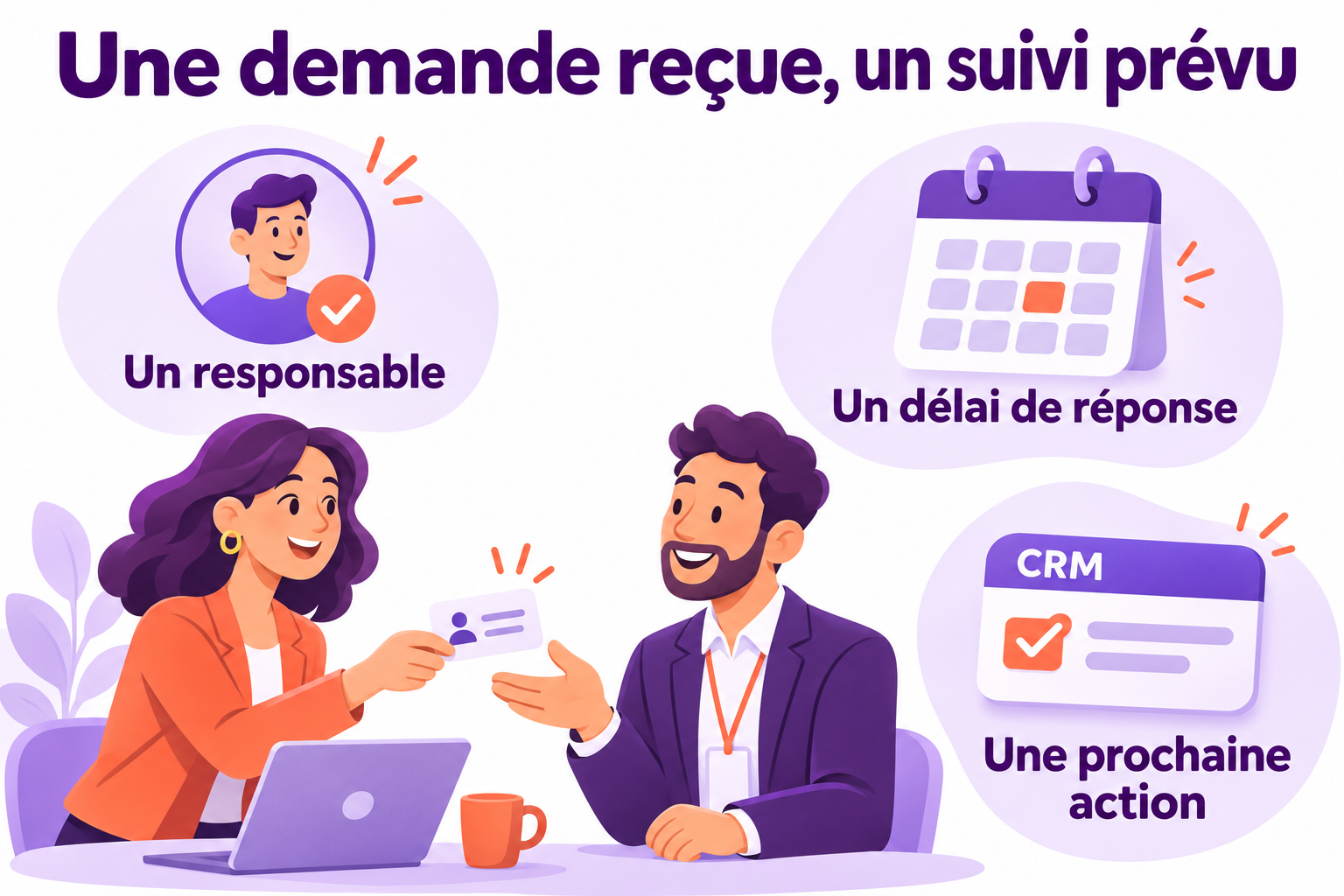
You can start with a few rules:
1. Assign a person in charge. Each request is assigned to a person who follows up on it.
2. Set a response deadline. For example, aim to provide an initial response within one business day for sales inquiries.
3. Qualify the lead. Verify the industry, the stated need, the contact’s role, and any project deadline.
4. Plan your next step. Schedule a meeting, send additional information, or set up an appropriate follow-up.
This information can be stored in a CRM. For a small, start-up organization, a properly maintained shared spreadsheet can already be helpful.
The key is for management, marketing, and sales to share a common vision.
Automation can also make your life easier: notifying the sales representative when a form is submitted, sending a confirmation of receipt to the prospect, and creating a follow-up task.
Be careful, however, not to confuse responding to a request with signing up for a marketing list. In Belgium, the sending of commercial emails is regulated, notably by a prior consent requirement and certain limited exceptions. Data subjects also have the right to opt out of direct marketing. You must therefore ensure that your forms, files, and communications comply with these regulations.
Here's a tip: Take a look at the last ten requests you've received. Do you know who handled them, how long it took, and what happened to them?
If the answer isn't clear, start by setting up this follow-up before investing further in customer acquisition.
The mistake to avoid: implementing too many automations before the sales process has been defined.
For small and medium-sized businesses looking to better organize this process, we detail qualification and follow-up methods in our article “Optimizing Your Sales Pipeline.”
7. Measure business opportunities, not just visitors
Your website is getting more visitors. Your LinkedIn posts are generating engagement. Your campaigns are getting clicks.
These results are encouraging, but they don't yet indicate whether your marketing efforts are contributing to your company's business growth.
To find out, you have to look a little further.
Which channels generate leads? Of these leads, how many match your priority personas? How many result in an appointment, a quote, or a sale?
You don't need a complicated dashboard to get started.
There are four indicators that can help you right away:
- The number of leads received, broken down by acquisition source.
- The quality of the leads, based on how well they match your target audience.
- The number of appointments or opportunities created to track the progress toward sales.
- The number of proposals and signed contracts, in order to gradually align marketing efforts with sales results.
Google Analytics 4 can help you understand user journeys and measure certain actions on your site. UTM parameters allow you to identify more precisely which campaigns are driving traffic. To track appointments and sales, however, you’ll need to cross-reference this information with your sales tracking data.
Also keep in mind that a B2B purchase isn’t always finalized within a few days. A prospect might discover your company on Google, read a case study, meet you at a trade show, and not contact you until several months later.
So don't judge an action solely based on the number of immediate requests.
Here’s a tip: Schedule a monthly meeting between the marketing and sales teams. Identify which initiatives are generating promising leads, the obstacles encountered, and one or two adjustments to test the following month.
The mistake to avoid: continuing to invest in a campaign simply because it generates a lot of clicks, without checking the quality of the leads.
Where should you start when building your B2B acquisition funnel?
You don't need to follow all seven tips at once.
For an SME looking to structure its acquisition process, we recommend starting with a simple initial workflow and then refining it based on feedback from the field.
Here is an example of a 15-business-day action plan.
Your First Funnel in Three Weeks
Week 1: Target and Offer
Analyze your existing customers, choose a priority persona, and identify a problem for which you can provide a concrete solution.
By the end of this first week, you should be able to clearly explain who your target audience is, what you’re offering them, and why your company can help them.
Week 2: Conversion Journey
Choose a marketing channel and prepare some content or a campaign. Then make sure the landing page clearly presents your offer, provides evidence of credibility, and makes it easy for visitors to get in touch.
There's no need to rebuild everything from scratch. Sometimes an existing page can be adapted.
Week 3: Follow-up and Launch
Make sure that requests are directed to the right place, that their follow-up is organized, and that key actions are measurable.
You can then run your first test, observe the reactions, and gather feedback from your sales representatives.
This timeline is intended to help you set up an initial version of the customer journey. You shouldn't expect definitive business results after three weeks, especially if your market has long decision-making cycles.
The key is to start with a system that you understand, that your team uses, and that you can improve.
Why not take stock of your acquisition with Maia Consulting?
Have you already implemented several marketing initiatives, but lack the time or perspective to figure out what’s actually working?
At Maia Consulting, we help B2B small and medium-sized businesses develop and improve their customer acquisition strategies.
Our work can begin with an assessment: identifying your personas, reviewing your acquisition channels, analyzing your website, and understanding how leads are passed on to your sales team.
We then identify priority actions, taking into account your goals, your budget, and the resources you have available.
Depending on your needs, a Maia consultant can be brought in for a one-time project or join your team on a part-time basis to assist you with implementation and follow-up.
There’s no need to use multiple tools or run multiple campaigns. The goal is to ensure your marketing and sales efforts work together, with clear priorities.
Would you like to improve new customer acquisition for your small business?
Let's discuss your acquisition strategy with a Maia consultant.