
Our Tips for Optimizing Your Facebook Campaigns
With nearly 3 billion active users, Facebook remains the leading social media platform. What’s more, advertising costs are affordable, and you can target your customers. But as with any marketing or advertising campaign, you need to develop your strategy before you begin and have a solid understanding of how the platform works.
Here are a few tips for optimizing your next Facebook Ads campaigns.
1. Create profiles of your customers
To be effective and achieve the best return on investment, you must first and foremost identify your target customers. This involves creating typical profiles (also known as buyer personas) so that you can then develop truly effective advertising messages. Try to create at least three customer profiles by asking yourself the following questions:
- What is their employment status (student, employee, retiree, etc.)?
- Where does he live (in the city, in the countryside, etc.)?
- What is his social status?
- What are his hobbies?
- What's wrong with him?
- What makes him happy?
In this exercise, try to be as objective as possible. Feel free to conduct research to validate your profiles.
2. Tailor your advertising message
For your campaigns to be truly effective, it is essential that the content aligns with your target audience, their needs, and their expectations. Therefore, the style, visuals, and messages must be tailored to the customer profiles you have established.
3. Set your goals
One of Facebook’s main strengths is its ad delivery algorithm. It works differently depending on your goals, so it’s important to clearly define your goals. Do you want to generate leads, drive traffic to your website, promote your Facebook page, or get more messages?
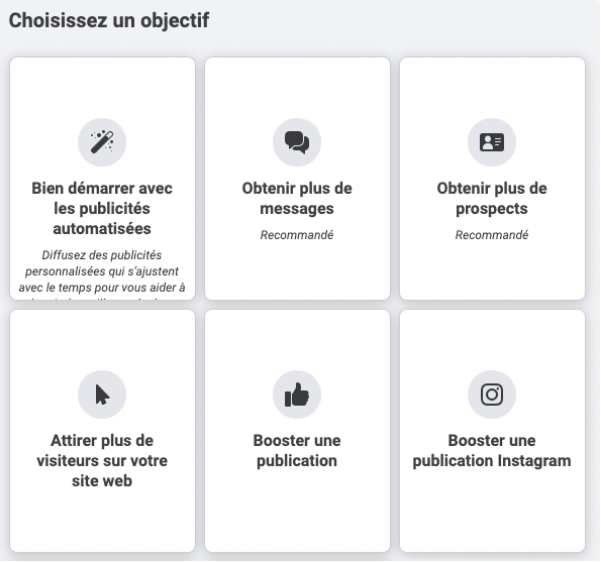
Depending on the objective you choose, Facebook will show your ad to different people whose behavior matches your objectives.
4. Advertising Costs and Budget Planning
Although Facebook offers fairly affordable advertising rates, it’s important to plan your budget carefully, as prices vary depending on your goals and your industry. As you might expect, you won’t pay the same amount for simply displaying your ad as you would for a purchase made on your website.
To prepare your campaign budget, you need to identify the costs associated with your goals.
Here are a few questions to ask yourself:
- How many leads would you like to generate?
- How much are you willing to pay per lead?
- What are your sales targets?
- How much are you willing to pay per sale made?
- What are your purchasing or production costs?
- This analysis will help you determine the profitability of your campaign.
5. The A/B testing feature
Facebook has added an essential feature to its campaign manager: A/B testing. This feature allows you to create variations of your ads and compare the results. This way, you can test different content, audiences, or even ad placements.
This strategy is much more effective than randomly testing by manually turning your ads on and off, which can negatively impact the effectiveness of the ad algorithm.
6. Messages, Design, and Inspiration
As mentioned earlier, your ad needs to “speak” to your target audience. The message must address a need or desire, and the style must align with the norms of the social group it’s aimed at. You don’t communicate with Generation Z the same way you do with baby boomers.
To help you with your creative work, Meta, Facebook’s parent company, provides a compilation of all the ads that have run on its platform. You can search for content by country and industry.

7. Facebook Pixel
And finally, don’t forget to place your Facebook pixel on your website. This is a tracking code that anonymously identifies what people do on your site after clicking your ad. It tracks conversions, provides the advertising algorithm with performance data, and therefore makes your campaigns more effective.