Marketing Guide for Small and Medium-Sized Businesses: Fully Understanding Your Target Audience and Their Needs
In a previous article, we highlighted the crucial importance of marketing positioning to a company’s success. However, the key to this positioning lies in a deep understanding of the target customer base and its needs, particularly for small and medium-sized businesses operating in the B2B sector. This understanding goes beyond simply knowing which companies to target, given that sales cycles are often long, complex, and involve multiple stakeholders.
Having a clear understanding of the characteristics and needs of decision-makers is essential for optimizing business performance. The buyer persona method is particularly valuable in this context. In this article, we’ll explore how it can be applied in your company, as well as how the consultants at Maia Consulting implement it for our clients.
What is a target, and why is it important to identify it correctly?
The target market represents the specific segment of the market that the company aims to serve with its products or services.
Consequently, the marketing department’s primary mission is to clearly define this target audience and understand its needs, in order to tailor the sales message as effectively as possible, guide the sales team toward the right contacts, and create engaging content that meets their expectations.
The accuracy of this identification makes it possible to optimize the entire marketing and sales process, from product design through to the final sale.
Modeling Your Target Audience Using the Buyer Persona Method
Of all the tools available for defining a target audience, the buyer persona is the best known and easiest for a small business to use. This method involves creating a detailed profile of the ideal customer by compiling firmographic, sociodemographic, and psychographic data.
To get a complete picture, it is crucial to ask the right questions regarding these three categories of criteria.
Here are a few examples of questions that may be discussed:
Firmographic criteria:
- How large is the target company?
- Where is this company primarily located?
- What industry is it in?
Sociodemographic criteria:
- What are this target audience's preferred communication channels?
- What are the most common challenges this company faces in its industry?
Psychographic criteria:
- What are the personal and professional goals of the decision-makers within this company?
- What are their core values and main motivations when it comes to purchasing and collaborating with external partners?
Buyer Persona: Harnessing Collective Intelligence
To develop the buyer persona effectively, it is recommended to organize a workshop that taps into the company’s collective intelligence by bringing together representatives from various departments that have direct or indirect contact with the target audience. This approach ensures a deep and comprehensive understanding of your customers, in all their complexity.
Furthermore, by involving all stakeholders, they will be more committed to using the buyer persona. This will subsequently facilitate the consistent integration of the workshop’s findings into the company’s various strategies.
Ensure the dissemination of the Buyer Persona
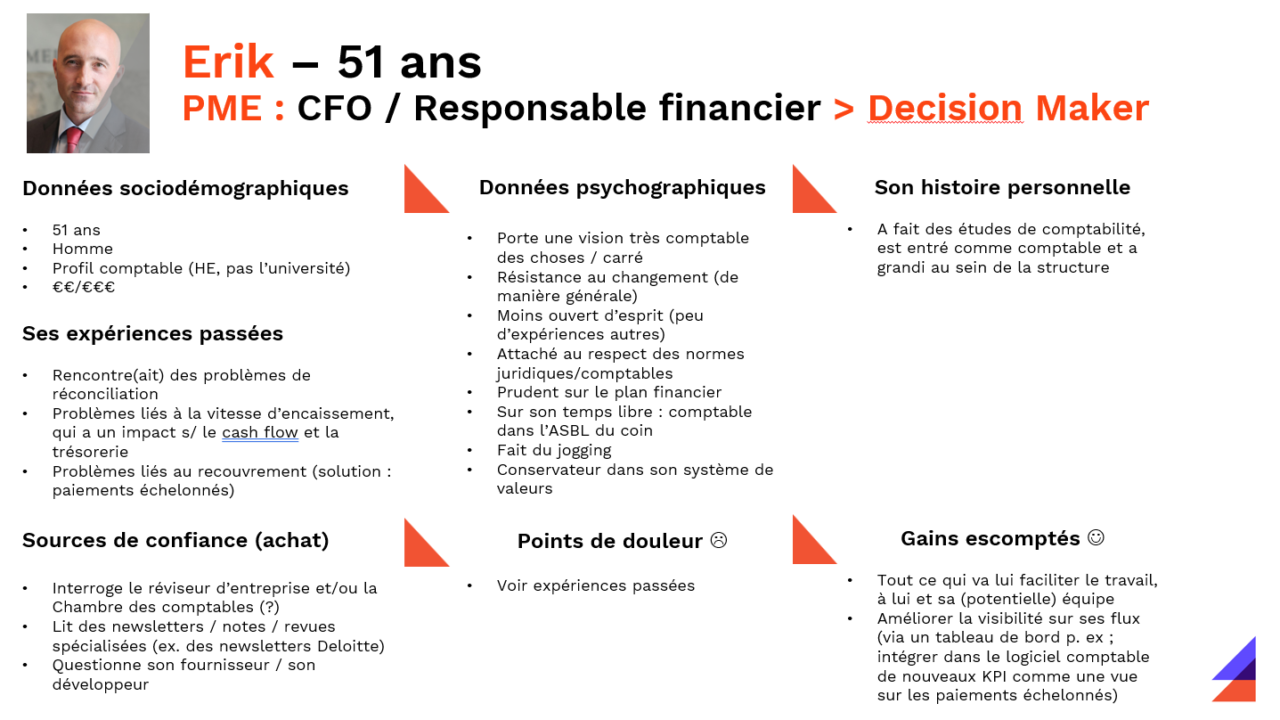
To facilitate the internal sharing of the buyer persona(s), it is recommended to create a concise, simple, and visually appealing summary sheet. This sheet summarizes the buyer persona’s key characteristics, such as the decision-maker’s role, their professional and personal goals, and their communication preferences.
Here is an example of a buyer persona profile created by Maia Consulting:
Mapping the Customer Journey
Once the buyer persona has been defined, the next step is to map out the customer journey.
The customer journey is primarily designed to help you:
- Identify key touchpoints throughout the decision-making process
- Ensure a seamless experience at every step
- Encourage actions as crucial as considering your product, purchasing it, or recommending your company.
Just as with the buyer persona, it is highly recommended to organize a workshop that actively involves all stakeholders who are in direct contact with customers in order to gain the most comprehensive view possible of the customer journey. We’ll discuss this in more detail in an upcoming article.
Conclusion
As we’ve seen, understanding your customers and their journey is essential to engaging them at every stage and eliciting positive responses. With this in mind, we strongly recommend organizing and facilitating workshops focused on creating buyer personas and tracking the customer journey.
Maia Consulting is here to support you through this process, helping you achieve comprehensive and actionable results for every department in your company. Please feel free to contact us to learn more about our approach.