Today, everyone agrees that “content is king.” But what exactly does that mean? Why is it so important for a company or brand to include content in its digital marketing and online communications?
High-quality content provides value to readers, whether through useful information, solutions to problems, or simply entertainment. This fosters a deeper connection with the audience, strengthening brand loyalty and trust.
Content plays a crucial role in search engine optimization (SEO). Search engines favor websites that regularly publish relevant, original, and high-quality content, which increases a business’s online visibility and drives more traffic to its website.
Publishing informative, well-researched content establishes a company as an expert in its field. This can strengthen the brand's credibility and reputation, which is essential for attracting and retaining customers in a competitive market.
Content is at the heart of most digital marketing strategies, including social media, email marketing, and content marketing itself. It serves as the foundation for telling the brand’s story, communicating with customers, and achieving various marketing objectives.
Content can be used to guide prospects throughthe conversion funnel, from awareness to the decision to buy. By providing valuable information at each stage, content helps convert visitors into leads and leads into customers.
Content creates a space forinteraction and for building communities around brands or ideas. The comments, shares, and discussions generated by high-quality content can strengthen users’ sense of belonging and engagement.
In short, content is king because it is the primary means by which a brand communicates, engages, and builds relationships with its audience, while supporting its goals for visibility and growth.
But producing high-quality content isn’t a piece of cake! It requires creativity, time, resources, and a bit of a budget—which isn’t always readily available or a strong point for SMEs operating in the B2B sector.
For all these small and medium-sized businesses, adopting artificial intelligence (AI) for content creation offers a promising solution, but one that is not without risks.
Benefits of AI for B2B SMEs
As marketers who use it on an almost daily basis, our experience has taught us that new generative artificial intelligence technologies offer four main advantages:
- Increased efficiency and productivity: Reduced time required to create content;
- In-depth personalization: The ability to generate hyper-personalized content for different audience segments;
- Automated SEO optimization: Automatic suggestions and integration of relevant keywords to improve online visibility;
- Innovation and Creativity: Suggestions for original content angles and formats to inspire marketing teams.
Increased Efficiency and Productivity
These are undoubtedly the most significant benefits of using artificial intelligence. AI is capable of generating content at an unprecedented speed, regardless of the type of content: text, of course, but also images and videos.
For example, it is now possible for an SME to produce several short videos based on well-thought-out scripts and prompts in a minimum amount of time using the right tools. This used to be a significant workload, tying up several people and requiring a budget to rent the location, manage the actors, and handle post-production editing.
Advanced Customization
Through advanced data analysis, AI can create hyper-personalized content that precisely meets the needs and preferences of each segment of your audience, thereby improving customer engagement.
By analyzing your website's traffic statistics, you can refine your approach to creating content.
Let’s take the example of a manufacturer of fabric sofas. If an analysis of their traffic shows that many visitors arrived at their site through searches related to fabric care or looking for the right way to remove a stain, this provides an opportunity to create more content focused on this specific topic—whether by writing a dedicated blog post or sharing a short instructional video on social media.
Automated SEO Optimization
Who hasn't played the game where you have to write a text that includes as many of the given words as possible? The exercise is often very difficult.
The science of SEO optimization is somewhat similar to this kind of exercise. Search engines require us to place anduse our keywords in our content to demonstrate the relevance of our web pages and thereby increase our company’s online visibility.
One of the benefits of artificial intelligence is that it can easily generate content that seamlessly and creatively incorporates all the keywords you’ve asked it to use in your prompt.
As a result, the content provided is automatically optimized for SEO, which is obviously a significant advantage.
Innovation and Creativity
We all tend to repeat “tried-and-true” formulas. Most marketers track and analyze metrics such as clicks, views, and likes to identify which posts or pages perform best.
Ironically, AI can add a touch of creativity by suggesting original angles and content formats, inspiring marketing teams to explore new avenues.
In this specific case, think of the AI assistant as the ideal new colleague—one who is constantly coming up with new ideas. One who will not only help you feel confident in your initiatives but also, and above all, suggest new avenues to explore and challenge you to consider them—avenues that may be more innovative or creative.
Risks and Considerations
While using a content generator offers undeniable advantages, it’s still important to exercise caution and not take everything at face value.
However, generating this content using AI carries risks that must be taken into account to avoid falling for the scam. We’d like to warn you about the three most common risks we encounter:
- Lack of a personal touch;
- Technological dependence;
- Loss of brand differentiation

Lack of a personal touch
Whether you’re a critic or even a fan of ChatGPT and the like, who hasn’t said at some point, “Ugh, another text churned out by AI…”?
It is clear that one of the biggest challenges in using AI for content creation remains its difficulty in matching the human ability to convey authenticity and emotion.
Yet this aspect is particularly important in the B2B sector, where relationships and trust are built on mutual understanding and meaningful interactions.
Content that lacks personalization may not resonate with the target audience, leading to lower engagement and a less favorable reception of the brand’s messages.
Captivating stories and real-life experiences—often used to create emotional connections—can lose their impact when generated by AI, which may fail to capture human nuances.
The key lies in how we use AI. We must use it wisely, as an assistant—reviewing and revising the text as needed, enriching the content with meaning and emotion—rather than promoting it to the role of editor-in-chief.
Technological Dependence
Relying heavily on AI for content creation can also lead to a dependence on these technologies.
This phenomenon raises several concerns:
• Reduced internal innovation:
• Overreliance can limit opportunities for teams to develop their own creative and technical skills, thereby reducing organic innovation within the company.
• Business continuity risks: In the event of a technical failure or changes to AI services, companies may find themselves unable to produce quality content—or any content at all—thereby affecting their operations and visibility.
Loss of differentiation/standardization of content
If all companies produce content that is similar, it becomes difficult for a brand to stand out in a saturated market.
Standardizing content can also dilute a brand’s unique identity and values, making it less clear what sets the company apart and makes it appealing to its target audience.
Always make sure to set yourself apart from your competitors to stand out.
Our tip: How to write effective prompts
The result provided by AI depends on the quality of your prompt and the information you’ve given it. So, to get the best result, take care when crafting your prompts. Spend a little time on them—the result will be all the better for it.
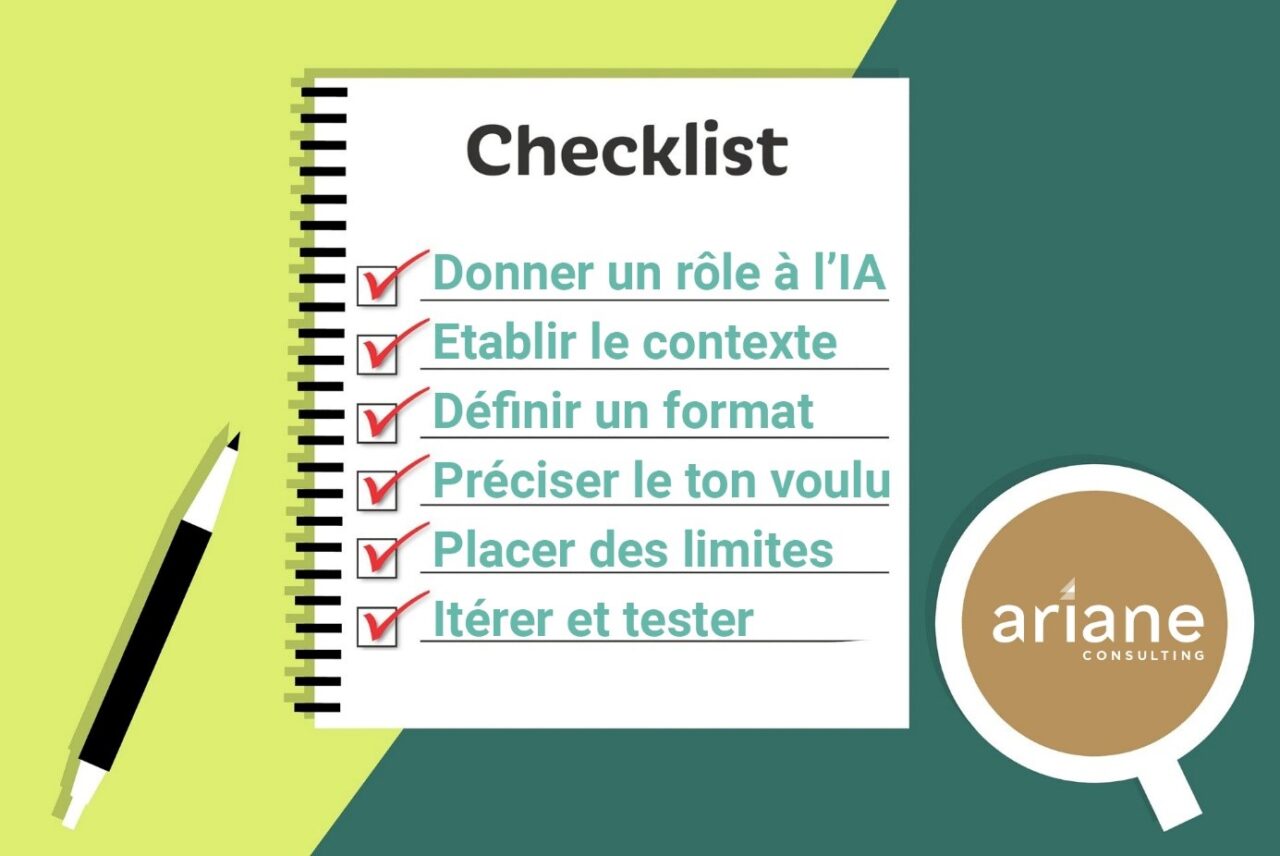
A successful prompt follows six guidelines:
- Give AI a role;
- Set the context;
- Define a format;
- Specify the desired tone;
- Set boundaries;
- Iterate and Test
Giving AI a Role
Never be too general—that’s the rule. When you’re expecting a specific result, assign a specific role to the AI.
Just like in a role-playing game, tell the machine what its character is.
Example:
“Act as the marketing manager for Company X, which produces Product Y.”
Setting the Context
Clearly state who you are addressing and what you hope to achieve.
Example:
“I would like to reach out to our B2B clientele—primarily engineers—and inform them about the launch of our new product, Z.”
Set a format
Specify the structure and, ideally, the expected word count.
Example:
“Write me a newsletter introducing the new Z product, with a catchy 10-word headline, an introductory paragraph, and a more detailed body paragraph. Add appropriate emojis.”
Specify the desired tone
Defining the tone may seem like a minor detail, but it’s actually very important. Using a tone that’s too friendly or too instructional can be completely counterproductive—or even turn your audience off.
Example:
“Write in an expert and professional tone.”
Setting Boundaries
Set clear boundaries to avoid a disappointing result or one that doesn’t meet your expectations.
Example:
“Write the post using a maximum of 850 characters. Do not include sentences longer than 30 words.”
Iterate and Test
Feel free to“edit,”add to, modify, replace, or change words, paragraphs, or parts of sentences in the provided text.
Example:
“Rewrite the first paragraph.”
Are you convinced of the benefitsof integrating AI into your content creation? Ready to generate effective prompts? Need help getting started? Feel free to contact us to learn more about our approach.
If you’re a B2B small or medium-sized business, Maia Consulting can help you increase your digital visibility. We can help you use AI to create your content.